How to align your timelines
Abandoning the 7-day week

“Sunday is for my long run.”
“We always hit the track on Tuesday.”
Spend enough time around endurance athletes and these phrases become second nature. Training is often organized neatly from Monday to Sunday, with specific sessions anchored to specific days.
Don’t be confused. This is an excellent way to structure training. A 7-day week is predictable, repeatable, and fits cleanly into the rhythm of modern life. For many athletes, it works extremely well.
But depending on the athlete and the context, it can also become a limitation.
The issue isn’t the structure itself but it’s the assumption that all meaningful training stress must be neatly contained inside a fixed seven-day box. This week we will discuss a practical approach to zooming out if you have found yourself struggling to manage a 7-day model.
Where the 7-Day Week Can Fall Short
Certain adaptations don’t care what day of the week it is. I spoke at length about this last week in the article below:
Recovery timelines, tissue remodeling, and neurological fatigue don’t reset just because Sunday night rolls into Monday morning. When we force all key sessions—long efforts, intensity, strength, technical work—into the same seven-day window week after week, we can unintentionally compress stress faster than the athlete can absorb it.
This shows up most often in:
Triathletes managing three disciplines
Athletes returning from injury
Athletes with high life stress or inconsistent schedules
Masters athletes with longer recovery needs
In these cases, the problem is not too much training, but too much happening in too short of a window.
Extending the cycle
One way to step outside the 7-day mindset is to pick a longer window, say 21 days, and flip the order in which you plan.
Instead of starting with total weekly volume and then trying to squeeze long or hard sessions into the calendar, begin by identifying a small number of key days across that 21-day span.
These are the sessions that actually move the needle:
Long endurance efforts
High-quality intensity sessions
Discipline-specific priority workouts
Strength sessions
Once those are placed, everything else becomes supportive.
This approach does a few important things:
It prevents key sessions from stacking too closely together
It reduces the temptation to force intensity just because “the week says so”
It allows recovery to exist by design, not by accident
A practical example
Athlete X is 57 years old and is a solid age group triathlete who understands the importance of strength training, aerobic volume, and careful application of intensity during the build phase of the season.
In order to get the most bang for his buck, he knows he cannot strength train when excessively fatigued and he cannot get the most out of his key endurance or intensity sessions if he is too sore.
Moreover, he has found himself on the sidelines when he ratchets up the run intensity with multiple hard runs per week. With this knowledge of timelines of recovery and interaction of multiple systems, he can structure his training blocks accordingly.
In the photo below we can see a calendar color coded for key days, easy days, strength days, and off days. The reason strength gets such attention is that unlike aerobic training, strength creates a high neuromuscular and connective tissue cost that does not always pair well with endurance intensity inside a compressed week.
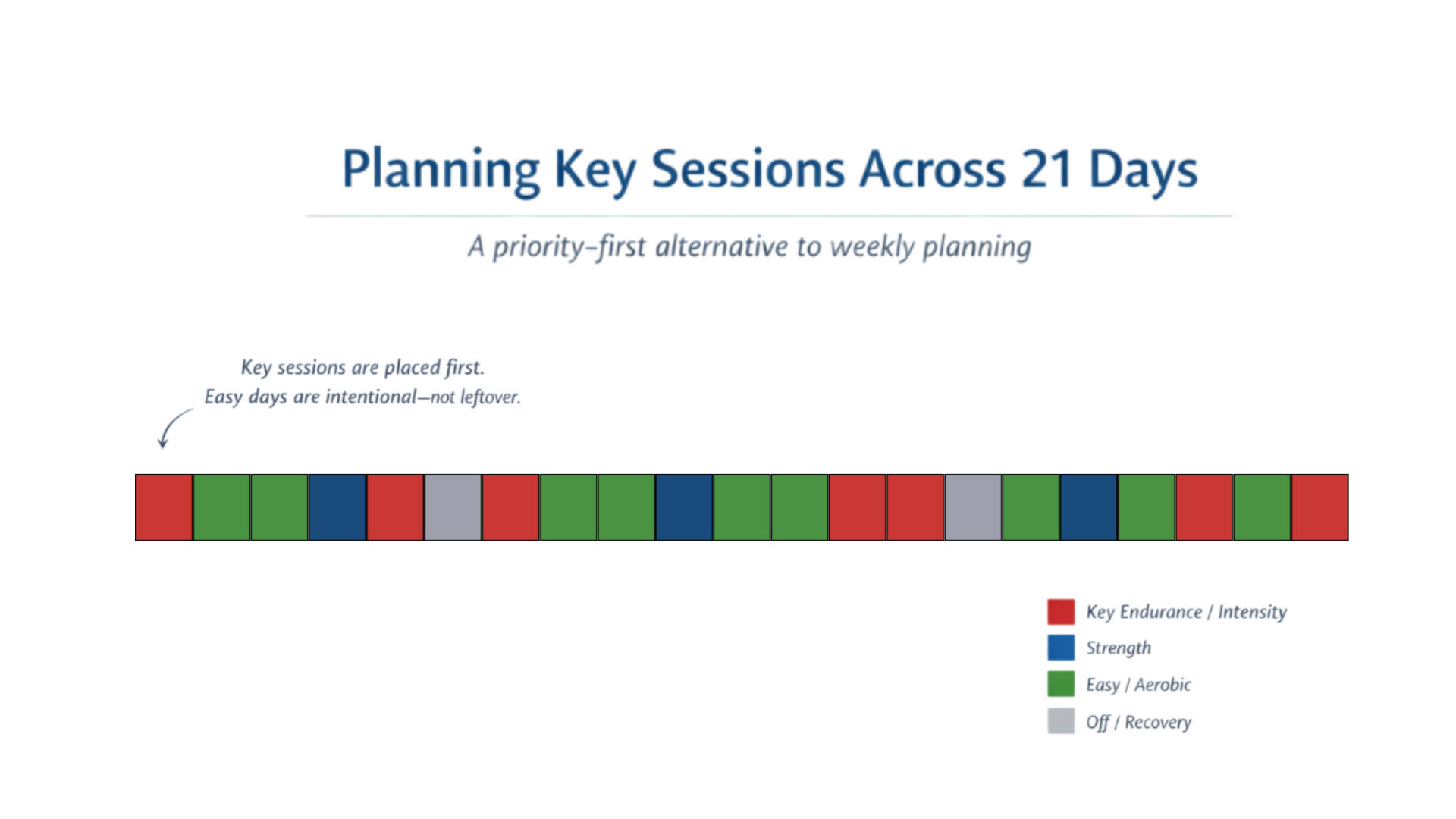
In the 21 days, Athlete X may achieve, for example:
Three main strength sessions (full body split with some supplemental days for frequency. The supplemental days can be done whenever as they do not generate much stress or fatigue)
Three endurance focused brick workouts (2.5 hours+ in total…various formats)
Two quality run workouts (track or hill reps)
Two longer endurance runs (> 90 min)
Half of the days easy or off
The premise is that if you are showing up, you are training, If you are training, you might as well be using your time to your advantage. You can come in guns blazing to the important days which brings the fervor you may use when approaching a race day. That is pretty cool.
Important: The total training load across 21 days may be similar to what this athlete would accumulate using three traditional weeks and the difference is how that load is distributed. It is a far cry from arguing to “do less” which is how this can be misconstrued. Moreover, as the athlete becomes fitter, he may even be able to compress density more as a way to challenge his physiology but not until he has proven he is outgrowing the extension of his training cycle.
Convenience vs. Capacity
Convenience should always matter in training. If a structure doesn’t fit an athlete’s life, it won’t last.
But sometimes the most convenient option isn’t forcing sessions into the calendar but rather giving yourself more space to absorb the work you’re already doing.
When training is spread more evenly:
Recovery improves without adding “extra rest days”
Quality sessions stay high-quality
Athletes stop feeling like they’re constantly behind the week “Ugh I gotta make it up!”
None of this is an argument to get you to change your training. It is not an effort to be contrarian. In fact, if the 7-day model is giving you repeatable and reliable results, keep doing it.
However, if you are scratching your head when comes to your ability to offer up consistent training performance, this is one way of thinking that allows program malleability outside the widely and logically accepted construct of the 7-day repeating cycle.
Do you want to see how effective it can be to have a program that adapts as you adapt?
Let’s talk about it on an EdgeCheck!
Hit the photo below to get started