
Pace pro
Level up your swim confidence Vol. III

Vol. I of the swim confidence series covered how frequently you need to be swimming to see gains.
Turning up to the pool 3-4 times per week nearly all year is going to keep paying off, especially if you are a newer swimmer and are following the technique cues from Vol. II. The improvement compounds when you are consistent.
The next and final step in the process is using the basics to increase your capacity to tolerate more work with less technical breakdown. The common approach is to huff and puff up and down the lane with the hope that over time the swimmer will become more tolerant to the “pain” or the effort required to hold a certain pace.
I had some success with this approach. I found it to be great for becoming work-hardened. However, this way rarely translates to better race-day performance whether it be a triathlon or open water swim race.
Enter learning how to pace.
Bridge across the zone
Workouts provide a perfect opportunity to practice pacing. Hitting the gas early in a set of 100s or 200s may provide a confidence boost on the first rep but leave you hanging on by the later reps. Establishing a pace zone instead of a pace target can eliminate some of this headache.
One of my favorite sets to work on “holding your horses” is:
5x400 with 15 seconds rest
This workout is intended to give you a view of your effective aerobic zone. You’ll be thankful to know that it is not a maximum test. Those hurt!
Using cues as a guide each rep should feel as follows:
“Guilty easy”
“Smooth”
“Long and strong”
“Steady”
“Breathing hard but not seeing red”
Using these cues, the pace should naturally come down with small increases in effort. Starting out too hot is going to result in a plateau or falling off the pace which defeats the purpose of the benchmarking. You should not finish this set feeling smashed.
Let’s have a look at my results from this set in December:
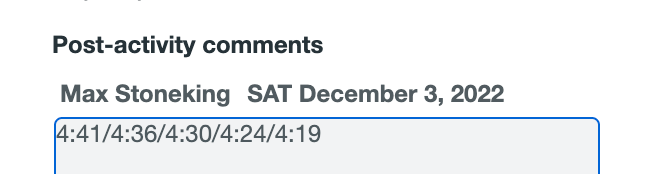
This is in a yards pool and gives a decent view into my effective aerobic range. The last rep was approaching threshold pace but felt pretty tame.
From this, I would prescribe myself an aerobic range of ~1:06-1:12 per 100 yards. When done correctly, the first 400 sets the floor while the last 1 or 2 400s set your ceiling.
Your mileage may vary on the size of the gap between the first and fifth rep, but do not fret, this simply gives you more room to operate in your pace zone.
This test set can be done frequently to check progress without breaking the bank on the intensity front. 2000 yards or meters well spent.
Develop gears
Can you successfully back up your easy swim volume with higher-intensity efforts?
This is a great question to answer and if the answer is no, the general aerobic volume is likely too intense for your current abilities.
Returning to the 5x400 day, I finished the workout with:
6x150 at T pace1 on :20 rest
6x50 best 400-meter/500-yard effort :10 rest
I was able to execute well and hit the desired times I wanted. This showed that I:
Paced the preceding 400s appropriately
Have developed gears
Having gears will help you get more out of each workout because it enables bridging across your effective range and arriving at a place where you can ramp it up instead of getting stuck at one pace.
Backloading your swim workout with the more intense efforts enforces the pacing discipline that can be forgotten in the race. Executing workouts like this frequently will:
Build your confidence in the pace you truly can hold in a race
Give you time to settle into your stroke in the workout
Correct technical breakdown in the face of muscular or cardiovascular fatigue
Relaxed is fast
If you fight the water, you will lose. Every. Single. Time.
Leveraging water is crucial to developing efficiency. With tense muscles, it is much more difficult to achieve the joint angles needed to grab loads of water. Vol. II went in depth about using the entire arm as a lever, and doing this effectively requires length.
Don’t fall victim to the short and choppy swim stroke that feels faster because it is more effortful.
Relax —> Lengthen —> Propel
I hope you have enjoyed the swim confidence series as much as I have. Getting into the weeds with swimming technique and training is a niche area I enjoy.
If you are looking to level up your swim further, head over to the Elite Edge Coaching website to set up a plan.
T pace for me is defined as an effort I can sustain in a 1500 or 2000 all-out swim. It has become more of a guess the further away from my swimming career I have moved. Today, I set this as 1:03-1:05 per 100 yards depending on the distance of repetition I am doing.
Please I want to know your opinion:
Olympic Triathlon CSS1’50”/100mt
2 weekly sessions of 2500/3000mt
Great resistance (no problem 2’/100mt open water for 3/4km..) low speed
What to do?
1. Speed?
2. Forza Pull/Paddles?
3. Aerobic Development (long repetition open water)?
Thanks!