

The Resilient Athlete
Your injury comeback playbook Part I

The next three weeks on Study & Sport are dedicated to talking about injury management including:
What contributes to injury
Benchmarking your entry point for rehab
Treatment considerations for popular overuse injuries
Facilitating your return to your desired activity
Part I starts it off this week by revisiting a subject from a past article that you can review below:

We know that physical stress is a given when training hard. This physical stress should be able to be tamed and adapted to so that you become stronger. When this stress is in excess, something has to give and this is often where injuries can pop up.
Does it mean your body is weak?
Does it mean that you have to correct some imbalances?
Does it mean you have to stretch more?
It might. But the first place you need to look is how your family, work, training life are organized.
Some injuries are traumatic, such as a bike accident. You may not be able to fully avoid something that falls in that category no matter how good your recovery and program design might be.
However, the vast majority of injuries in endurance sports are due to overuse from poor training, equipment, or recovery.
As mentioned in one of my favorite recent reads, The Nature of Training by Manuel Sola Arjona, “It is almost always a process, not a [single] reason…and whatever happens to you depends not just on the last event, but on the entire path.”
There often needs to be a multimodal approach to breaking the cycle of injury. Strengthening or stretching may be indicated, but if your entire program sucks, you’ll be patching holes at best.
Want to pave your way back from injury or ailment?
Hit the button below to check out the ReBUILD program with Elite Edge Coaching.
Personalized rehab strategies that go beyond a list of basic exercises

Tolerance and Capacity
Many injuries in running, cycling, swimming or multisport don’t take you out completely. This is what makes injury management difficult and is defined as your tolerance for activity.
“I can run but it hurts after xx miles” is much different than “I can barely move my leg without pain”.
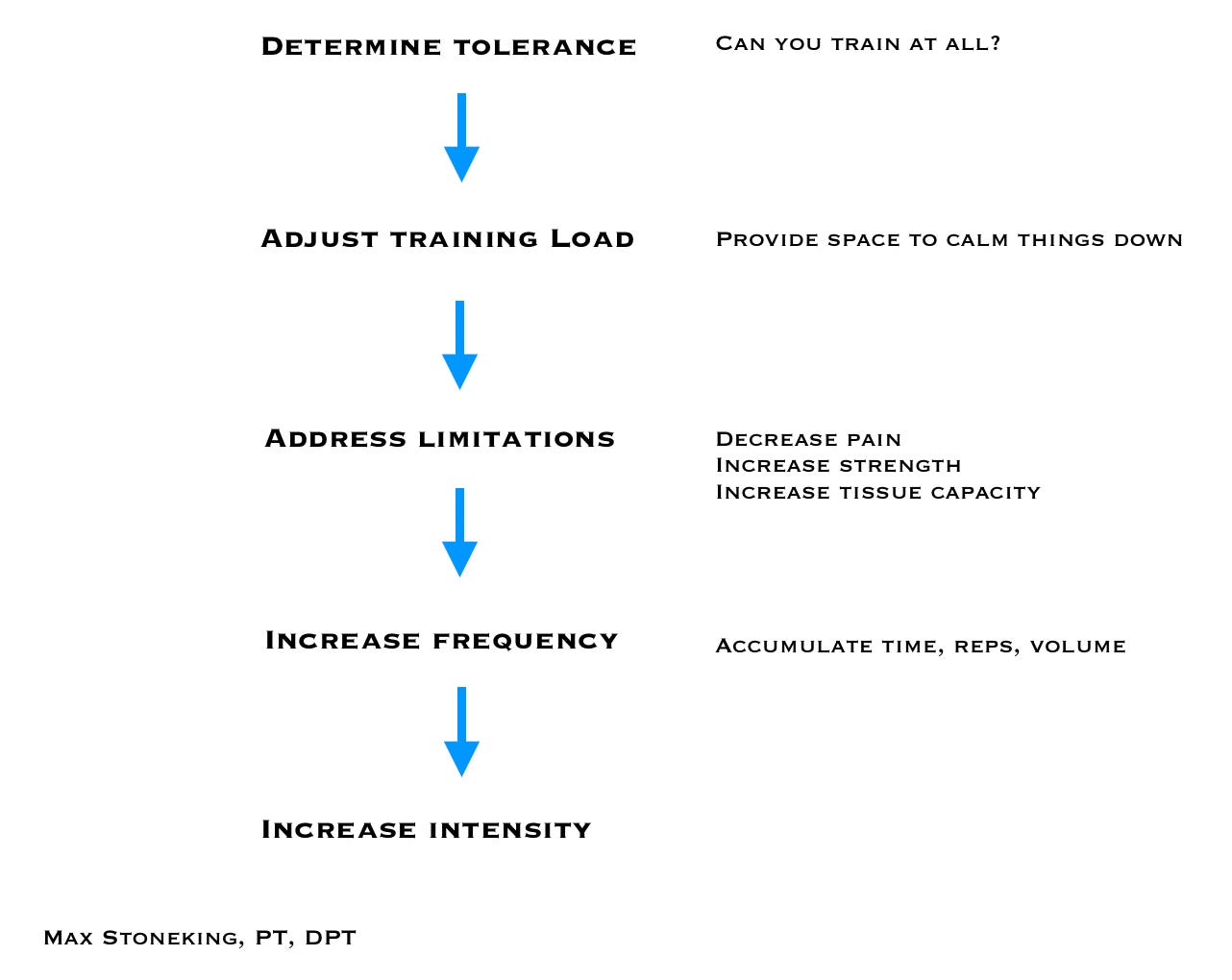
Your level of tolerance for certain activities related to your sport is crucial to determining your entry point for rehab. You might have to rest completely or you might be able to continue training at a level that you can tolerate.
Once you know your tolerance level, the next step in the process is increasing your capacity.
To make this more clear, let’s have a look at an example
Athlete X has had some nagging right knee pain for months. He has been running through pain on most days and “just putting up with it”. He can complete 2-3 miles before the pain sets in and after that, it worsens to the point where he needs to take pain medication to make it through the workday after running.
We can benchmark his tolerance at roughly 2-3 miles of running. The next thing we need to determine is the rate-limiting step that is preventing him from running further without pain.
In a physical therapy setting, we’ll look at strength, flexibility, and mobility of knees, ankles, and hips. An assessment of plyometric tolerance for jumping or other high-rate loading is also a good call. We may look at running form if there are any GLARING gait deficits.
To me, these are important but not all-encompassing assessments. An equally important conversation to have is on training habits. Recent ramps in volume or intensity are common injury culprits. Fatigue is a common denominator in many injuries and I am going to be VERY focused on this element in my clinical examination of Athlete X.
We move differently when we are tired, offloading forces to other areas as our body searches for the most simple solution to a complex task. Fatigue may also present as mental exhaustion that inhibits good decision-making as to when to take a rest day.
In this case, there may be measures such as strength that are lacking, but the true rate-limiting step for Athlete X could be that he simply has increased his volume or intensity far quicker than his physical body can handle.
We’ll tap into the isolated capacity issues (strength, etc..) AND the systemic capacity issues (poor sleep, poor training, etc..). Only looking at one or the other does not maximize the potential for breaking the cycle of injury, nor does it give Athlete X a chance at improving performance.
It is one thing to improve symptoms in an athlete, but I don’t think you would be mad at me if I also helped you improve your athletic performance. Faster is fun.
For Athlete X, he may need to stick to 2-3 mile runs initially while the isolated deficits are addressed. From there, we will aim to slowly increase his running capacity with a smaller ramp rate in volume and intensity while progressing the interventions for strength, mobility, and flexibility. Sitting on the sidelines and waiting it out is not required in this scenario. Athlete X can run to tolerance and he SHOULD. A long-term break is going to make the return more difficult.
Handing out some exercises without guidance for getting ready to perform is incomplete rehab. You must finish the job!
As can be seen in the example, defining your tolerance and current capacity are essential for initiating a successful rehab program. You will rarely get an overnight fix to many of these issues. If you do find a quick fix, you did not truly have an injury.
In Part II of the series, we are going to have a look at common injuries in endurance sports and what you may be able to do immediately to jumpstart the rehab process. It will be important that you remember these strategies are to be used as a supplement to a broader conversation of changing your training program or lifestyle; thus allowing yourself to pave a path back to the level you desire.
